What Is an IBAN? How International Bank Account Numbers Work
Understand what an IBAN identifies, how its parts fit together, when you need a BIC, and what a successful format check can actually tell you.
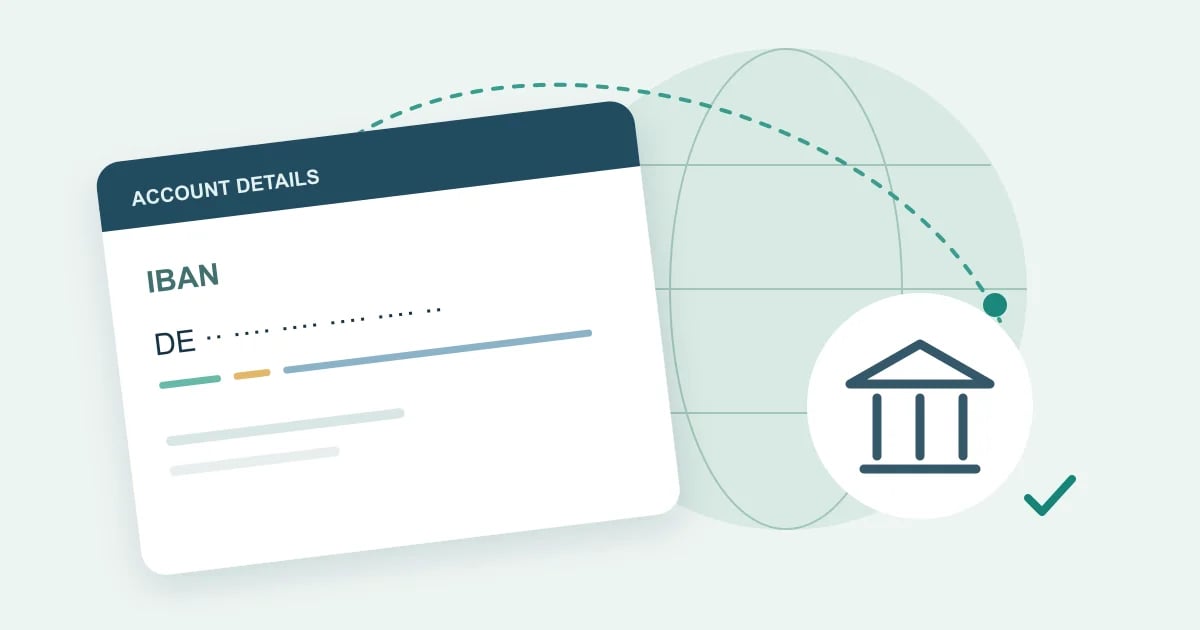
Someone asks for your IBAN so they can send you money. You open your banking app and find a long string of letters and numbers. Is that your account number? Do you also need a SWIFT code? And why does another person’s IBAN have a different length?
What an IBAN is used for
An IBAN gives participating banks a consistent way to describe an account across borders. Instead of asking the sender to understand a country’s domestic account numbering system, a payment form can accept one structured identifier. Banks also use IBANs for domestic payments in many countries that have adopted the standard.
Imagine paying an invoice from a supplier abroad. The supplier provides their beneficiary name and IBAN, and your bank asks for the amount, currency and reference. The IBAN answers the account-identification question. The other fields still matter: a correct account identifier does not explain which invoice you are paying or choose the payment currency for you.
The standard does not cover every country or every type of payment. If a recipient’s bank does not use IBANs, request its official receiving instructions. Do not manufacture an IBAN by adding a country code to a domestic account number.
How an IBAN is structured
An IBAN starts with a two-letter country code, followed by two check digits and a country-specific Basic Bank Account Number, or BBAN. The BBAN may include a bank identifier, a branch identifier, the account number and national check digits. Its exact arrangement depends on the country.
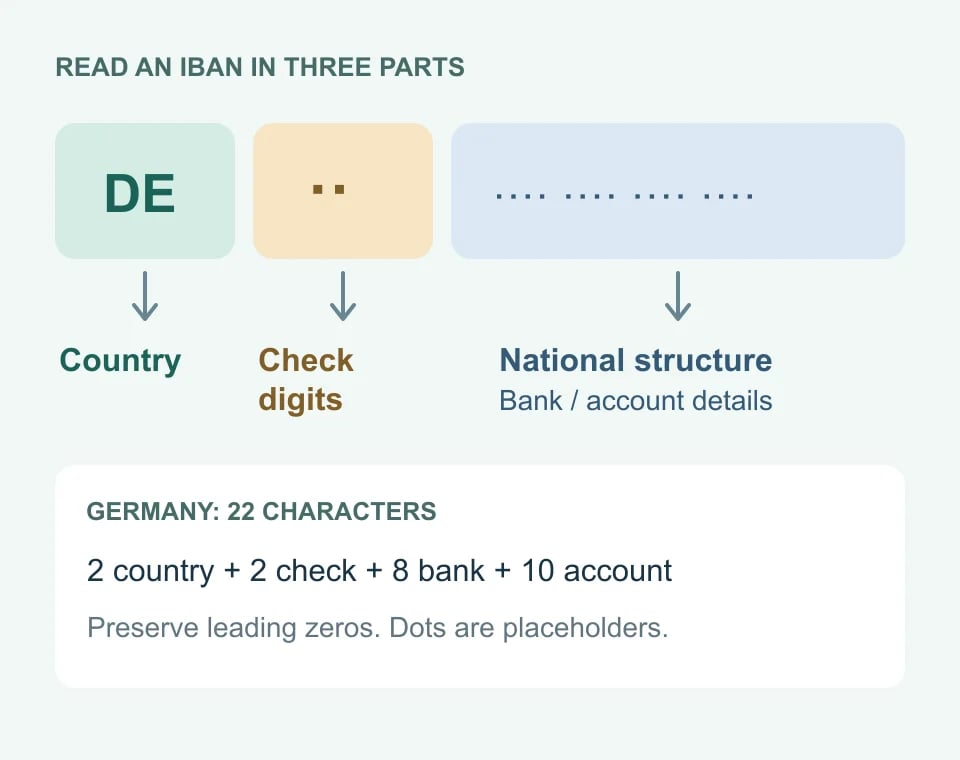
The international check digits support a mathematical consistency check. They help detect many typing mistakes; they do not encrypt the account details. Spaces make printed IBANs easier to read, but they are not part of the electronic identifier. A form may remove spaces automatically or ask you to enter the value without them.
Germany’s IBAN has 22 characters: DE, two check digits, an eight-digit bank code and a ten-digit account number. Keep leading zeros. In a bank identifier, zero is a meaningful character, not a number-formatting preference. These structures are documented in the official SWIFT IBAN Registry.
Why IBAN lengths differ between countries
Each participating country defines its own fixed IBAN length within the international maximum of 34 characters. A longer IBAN is not more secure or more complete. It reflects a different national account structure. Compare the number with the requirements for its country, not with the length of your own IBAN.
| Country | Prefix | Total characters | National structure after the check digits |
|---|---|---|---|
| Germany | DE | 22 | Bank code + account number |
| Netherlands | NL | 18 | Four-letter bank identifier + account number |
| United Kingdom | GB | 22 | Bank identifier + sort code + account number |
| France | FR | 27 | Bank + branch + account + national check digits |
These four examples come from the SWIFT registry linked above. They also show why an IBAN is not necessarily all numeric after its prefix: some countries use letters in the bank or account portion. A form that rejects every letter after the country code will reject legitimate formats.
IBAN, account number, BIC and SEPA: the difference
The terms often appear together on invoices, but they describe different things. An IBAN identifies an account in an international format. A domestic account number belongs to a national system. A BIC identifies an institution or, with an optional branch identifier, a more specific part of it. SEPA refers to payment schemes, not another account number.
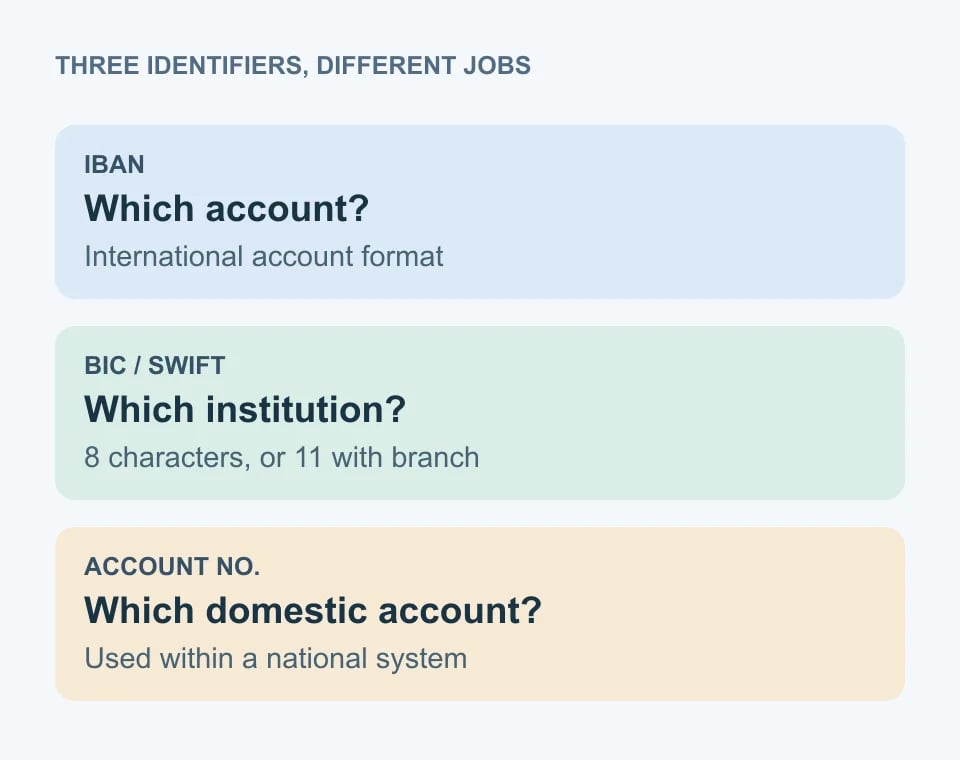
BIC means Business Identifier Code. It has eight characters, with an optional three-character branch identifier. “SWIFT code” commonly refers to a BIC. Knowing a bank’s BIC does not tell you a customer’s IBAN, and a BIC’s existence alone does not establish that it is connected to the SWIFT network. See SWIFT’s BIC explanation.
You do not always need to provide both. For SEPA euro credit transfers and direct debits, the IBAN-only rule generally means customers do not supply a BIC. Other international payment instructions may request it. Follow the receiving bank’s instructions and your payment form rather than assuming one rule applies to every transfer. The European Payments Council explains the standards and IBAN-only rule.
An IBAN tells a payment system which account is being referenced. It does not tell you whether the person asking for money is trustworthy.
Where to find your IBAN and how to share it
Start with the account-details section of your bank’s official app or online banking service. Statements may also show an IBAN. If you have several accounts, select the account intended to receive the payment; do not assume one identifier applies to every account you hold. Your bank can confirm whether that account has an IBAN and provide receiving instructions.
Copy the value directly if possible. Re-entering a long identifier from a screenshot creates unnecessary opportunities for mistakes. If you are sending your details to a customer, use a clear layout with separate labels for beneficiary name, IBAN, and any additional information your bank requires. Include an invoice reference separately rather than putting it inside the IBAN field.
For incoming payments, sharing the required account details with the payer is normal. Publishing bank details widely is a different decision. Keep passwords, one-time codes and banking-app approval requests separate: someone sending you money does not need your login credentials. Ask your bank about an unexpected request rather than treating the presence of an IBAN as reassurance.
A short checklist for finding the right account details
- Open your bank’s official app or website directly and select the account that should receive the payment.
- Look for Account details, International details or a similar section; labels vary between banks.
- Compare the beneficiary name and account selection before copying the full IBAN.
- If it is absent, check a bank-issued statement or ask the bank for its receiving instructions. Do not invent or reconstruct missing details.
| Detail | Identifies or describes | Where to obtain it |
|---|---|---|
| IBAN | The account in an international format | Bank-issued account details |
| Domestic account number | The account in a national system | Bank-issued domestic details |
| BIC / SWIFT code | The institution or branch | The bank’s receiving instructions |
| Payment reference | Why the payment is being made | Invoice or agreed payment instructions |
For a larger comparison of lengths and national structures, see IBAN formats by country. To understand what happens after the details are entered, read SEPA transfers explained.
Check a payment in three practical steps
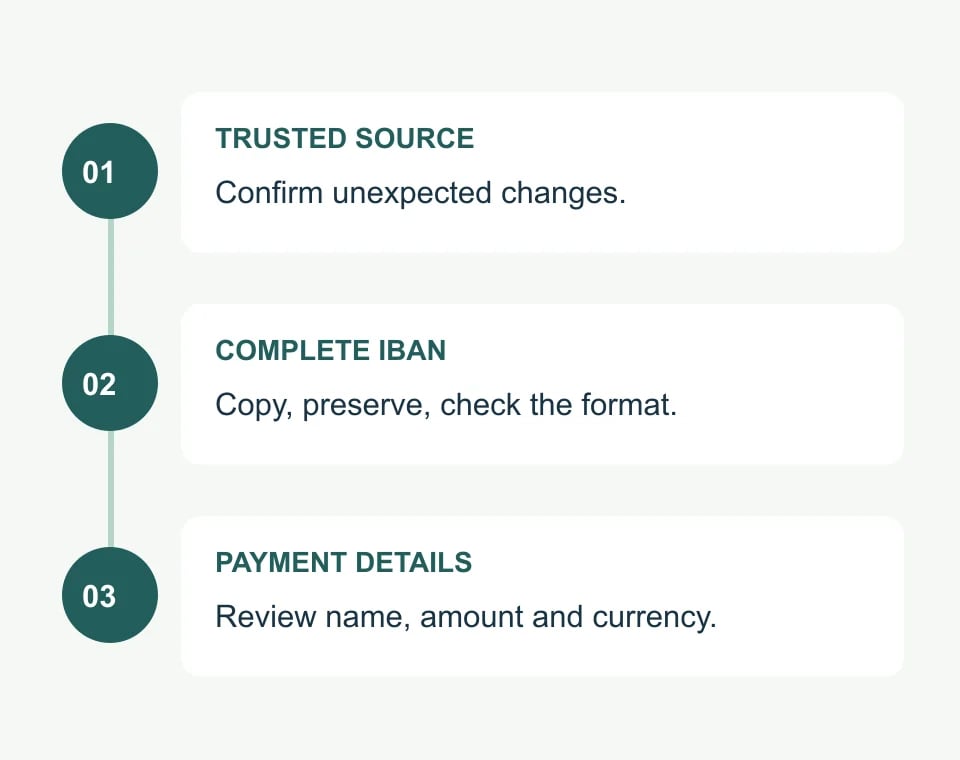
- Confirm the source. Obtain the details from the intended recipient through a trusted channel. If an invoice suddenly changes bank details, verify the change using contact information you already trust.
- Check the identifier. Copy the complete IBAN, review its country prefix and look for missing or extra characters. A format validator can help flag structural problems.
- Review the payment. Check beneficiary name, amount, currency and reference in your bank’s confirmation screen. Take any beneficiary-name mismatch or other bank warning seriously.
For example, suppose a regular supplier emails a replacement invoice with a new IBAN. A validator accepts the number. That answers a narrow question about its structure; it does not confirm that your supplier requested the change. Contact the supplier using a previously established channel before relying on the replacement details. The important check is the change of destination, not simply whether the digits add up.
What IBAN validation can and cannot prove
A validator can examine supported country rules, length, allowed characters and the international checksum. Some tools also check national structures or bank reference data. Coverage differs, so read the result carefully: “checksum passed” and “all supported national checks passed” are different statements.
If you want to explore the format, use a synthetic example with the IBAN validator. For developers, the separate article on IBAN validation explains the testing boundary in more detail. A generated example is useful for checking a form; it is not a bank account and should never be used as payment instructions.
Common questions about IBANs
Is an IBAN the same as my card number?
No. A payment card number and an IBAN serve different systems. A card linked to your bank account does not make the two identifiers interchangeable. Use bank-provided account details for a transfer and the relevant card details for a card payment. Our explanation of how credit cards work covers that distinction.
Can I work out someone’s name from an IBAN?
A public format check does not reveal a verified account-holder name. Some banking services offer separate beneficiary verification during payment setup. Do not confuse that bank-provided service with decoding the characters of an IBAN.
What should I do when a form rejects the IBAN?
Check for copying mistakes, accidental punctuation and an unsupported destination country. Compare the value with the bank’s original instructions. If it still fails, ask the bank or payment provider what the error means; do not keep changing digits until the form accepts them.
Does a correct IBAN guarantee a successful transfer?
No. Payment eligibility, account status, currency, compliance checks and the other instructions still matter. A format check is useful preparation, while your bank handles the actual transfer and its status. Keep the payment confirmation and reference so you can follow up through the bank if necessary.