SEPA Transfers Explained: Standard, Instant and Direct Debit
Understand who starts a SEPA payment, how standard and instant transfers differ, and what to check before paying an invoice or setting up a direct debit.

An invoice asks for a SEPA transfer. Your banking app offers both a standard and an instant option, while your electricity provider wants a direct debit mandate. All three involve a bank account, but the person starting the payment and the steps you need to take are different. Knowing that distinction is more useful than treating SEPA as one universal payment button.
Start with the three payment types
| Type | Who initiates the payment? | Typical use |
|---|---|---|
| Standard credit transfer — SCT | The payer instructs their provider | Paying an invoice or setting up a standing order |
| Instant credit transfer — SCT Inst | The payer instructs their provider | A euro transfer that needs a rapid result |
| Direct debit — SDD | The creditor requests collection under a mandate | An authorized bill or subscription collection |
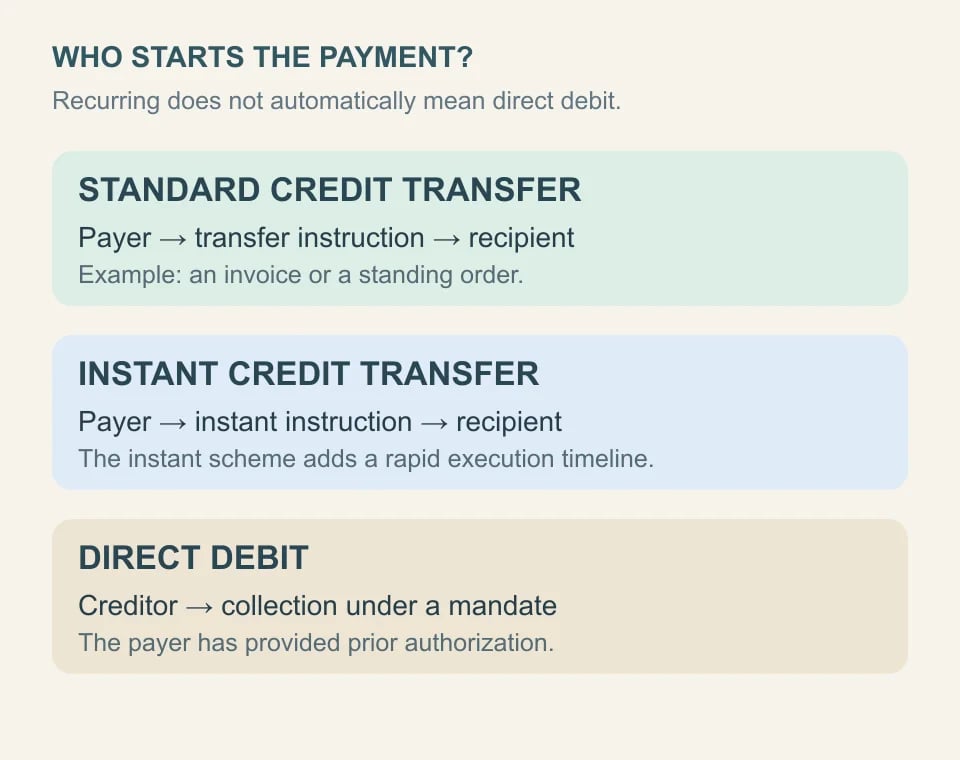
Think about the action, not just the frequency. A monthly standing order is still a credit transfer you instruct. A monthly direct debit is a collection requested by the biller under a mandate. Both can recur, so the phrase “automatic payment” alone does not tell you which arrangement you have.
How a standard SEPA credit transfer works
You enter the recipient details, amount and payment reference, then authorize your provider to send the payment. The providers process it through the scheme, and the recipient sees the incoming credit. The reference helps the recipient connect the money with an invoice or another obligation. The European Payments Council’s SCT overview describes both single and recurring transfers.
For an invoice, the useful preparation is straightforward: confirm who should receive the money, use their bank-provided account details, enter the correct amount and preserve the invoice reference. If the supplier has recently changed account details, verify that change through a contact channel you already trust before authorizing payment.
Standard electronic euro transfers generally follow a business-day timetable. A weekend or public holiday can affect when processing starts. Check the bank’s displayed execution date instead of assuming that “sent today” always means “received today.” The ECB’s comparison of standard and instant payments explains why the distinction matters.
What changes with a SEPA Instant transfer?
SCT Inst is designed for execution within ten seconds, around the clock, on every day of the year. That is a characteristic of the instant scheme, not a description of every payment labelled SEPA. The relevant providers, route and transaction still need to support the service. See the EPC’s SCT Inst scheme information.
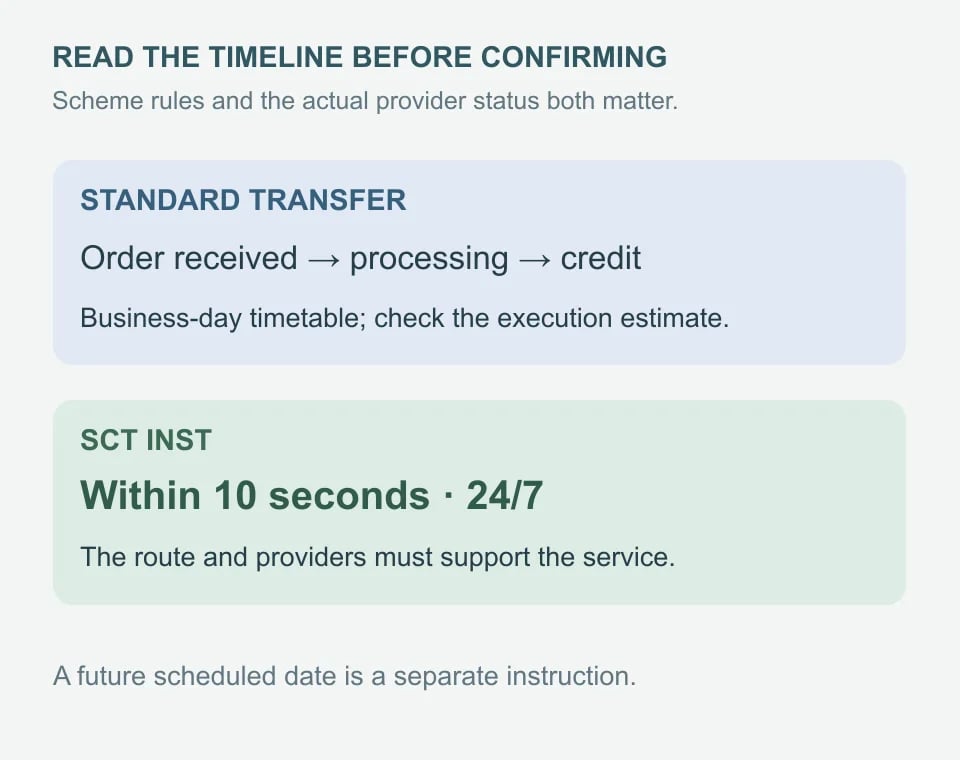
Rapid execution makes the review screen particularly important. Compare the amount and beneficiary before confirming, and read any warning rather than treating the faster option as automatically preferable. If you have made a mistake, contact your provider immediately. Do not assume that an instant payment has a convenient period in which you can undo it yourself.
The EU Instant Payments Regulation introduced requirements for availability, charges and verification of payee, with implementation dates that depend on provider type and location. Some deadlines fall in 2027. A rule introduced for one group of providers is not proof that every provider in the wider SEPA area must already offer identical functionality. The ECB’s implementation overview explains those distinctions.
Direct debit: collection under an agreement
With a direct debit, the biller initiates collection after you provide a mandate. The mandate is the authorization arrangement; an IBAN on its own is not a substitute. SEPA Direct Debit has Core and Business-to-Business schemes. Core is designed primarily for consumers, while B2B is for business payers. Both can support one-off or recurring collections.
Their refund rules differ. The EPC describes an eight-week no-justification refund window for Core collections and up to thirteen months for unauthorized collections. B2B does not offer the same refund right for authorized transactions. Contact your provider promptly about a disputed debit and identify the applicable scheme; do not assume a credit-transfer complaint follows direct-debit rules. EPC direct-debit explanation.
Does SEPA mean the payment is free?
No. The scheme and the price of your account are separate questions. Within the scope of EU cross-border payment rules, a euro payment to another EU country must not cost more than an equivalent domestic payment. That does not mean the equivalent domestic payment is free, and currency conversion is a separate cost to review. Your Europe’s payment guidance explains the distinction.
Under the applicable instant-payment rules, charges for an instant euro credit transfer cannot exceed those for the corresponding regular transfer. Check which rules and deadlines apply to your provider, along with its tariff and the details shown before authorization. Avoid comparing a headline fee without checking the currency, channel and account product involved.
For a practical comparison, write down the amount the recipient expects, your account currency, any stated conversion charge, the transfer fee and the estimated execution time. If the app offers several routes, compare those exact fields. A low transfer fee alone does not explain the total cost when currency conversion is also involved.
IBAN, BIC and recipient-name checks
An IBAN identifies the account in an international format. A BIC identifies an institution. Under the IBAN-only rule for relevant SEPA euro transfers and direct debits, customers generally do not need to supply a BIC; the providers handle the necessary institution information. Follow the actual payment instructions for the route you are using. EPC explanation of the standards.
Recipient-name verification is another layer. The bank may compare the beneficiary name with the account identifier and inform you of a discrepancy. That is different from calculating an IBAN checksum. A public format validator cannot stand in for the bank’s recipient-checking service. If a warning appears, resolve the discrepancy before relying on the account details.
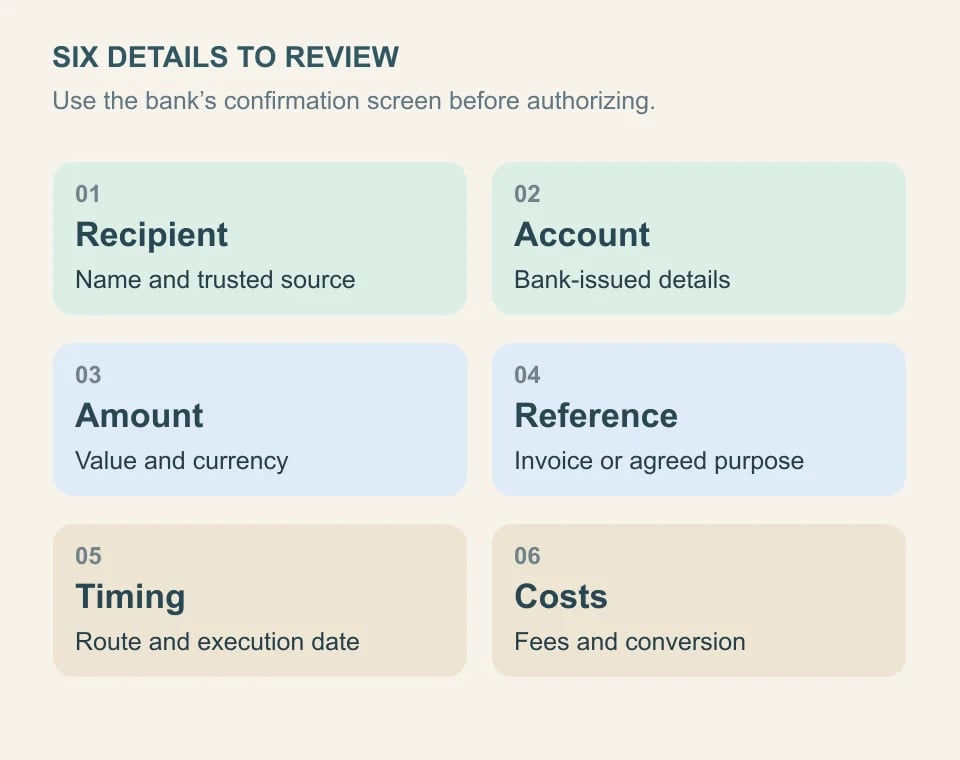
The account identifier, the payment scheme and the bank’s confirmation each answer a different question. Review all three before treating a payment as complete.
Work through a simple invoice example
Imagine a designer sending a euro invoice to a client in another participating country. The invoice supplies the beneficiary name, IBAN, amount and invoice number. The client checks the source of those details, enters them into the bank’s transfer form and uses the invoice number as the reference. The bank then offers the routes available for that account and payment.
If the client chooses a standard transfer, they review the execution estimate and authorize it. If an instant option is available, they review that option’s conditions before confirming. In either case, the designer should reconcile the actual incoming payment with the invoice. A message saying “I have entered the transfer” is not the same evidence as a credited account.
Now change the scenario to a monthly service collected by direct debit. The customer supplies a mandate through the provider’s process, and the biller initiates the collection according to the agreement. The customer should understand the collection arrangement and monitor account activity. The payment has not become a standing order simply because the same amount is collected each month.
When a payment does not go as expected
| What you see | What to check next |
|---|---|
| IBAN format error | Compare with bank-issued details; inspect country, length and characters |
| Recipient-name warning | Verify the beneficiary information through a trusted channel |
| Instant option unavailable | Ask about provider participation, route, limits and account eligibility |
| Pending or scheduled | Read the status and execution date before sending a second payment |
| Rejected or returned | Ask the provider for the actual reason and correction process |
| Unrecognized direct debit | Contact the provider promptly with the collection details |
Keep the payment reference, time, amount and provider’s status when asking for help. Avoid sending complete banking details in public support posts. If an app times out, check its transaction history before repeating the instruction: an interrupted screen does not prove that the original payment request was never received.
Common questions about SEPA payments
Is SEPA the same as the euro area or the EU?
No. The scheme’s geographical scope and the membership of those political or currency areas are different. A country’s inclusion also does not mean that every provider offers every scheme. Check the EPC’s scope information and the provider’s actual participation for the service you need.
Is SEPA a replacement for SWIFT?
They describe different things: SEPA provides euro payment schemes, while SWIFT provides financial messaging and related services. A generic “SEPA versus SWIFT” label is not enough to determine a route, fee or delivery time. Ask the bank which service applies to the particular currency and destination.
Can I use a generated IBAN to try a real transfer?
No. Generated values are for isolated tests within their stated limits. They do not identify a verified destination for your money. Developers should use the payment provider’s designated sandbox and scenario inputs; our test IBAN guide explains that boundary.
Where should I start if I only want to understand my IBAN?
Read what an IBAN is for the basics, or use the country-format comparison to understand different lengths and structures. For an actual transfer, use bank-issued receiving instructions and the provider’s current payment details. This article was checked against the linked official sources on 4 October 2026.