
How Credit Cards Work: Payments, Card Numbers and Security Codes
Follow a card payment from checkout to your statement. Learn what card numbers and security codes mean, how repayment works, and what format checks cannot prove.
A credit card can make checkout feel almost instant, but several separate things happen behind that small “approved” message. Your issuer checks a payment request, the purchase eventually appears on your account, and you repay the issuer according to your card agreement. Understanding those stages makes everyday questions much easier to answer.
Credit card, debit card or prepaid card?
The cards can look almost identical and may carry the same payment-network logo. The important distinction is where the money comes from. With a credit card you borrow and later repay. A debit card usually spends money from a linked account, while a prepaid card spends money loaded onto it. Overdrafts, fees and specific product terms can add further conditions.
| Card type | Main source of spending money | What to check |
|---|---|---|
| Credit | Credit provided by the issuer | Repayment terms, interest and fees |
| Debit | Money in the linked account | Balance, holds and any overdraft terms |
| Prepaid | Previously loaded funds | Available balance, reload options and fees |
A network logo alone does not settle which product you have. Check the account agreement or the product name in your issuer’s app. The Consumer Financial Protection Bureau’s comparison explains these basic differences. The examples below describe a typical revolving credit card; individual products and local rules vary.
How a credit card payment works
At checkout, the merchant sends a payment request through its payment providers and the card network to the issuer. The issuer decides whether to approve or decline it. Its decision can depend on available credit, security checks and other account conditions. The response returns to the merchant so checkout can continue.
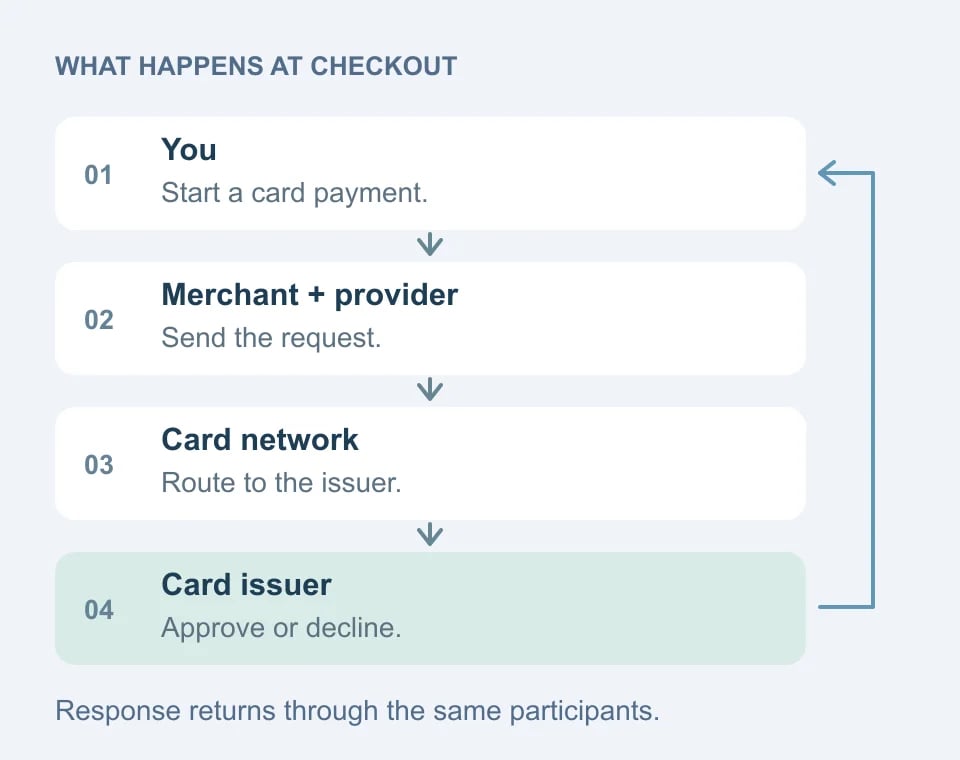
Authorization is not settlement. An approved request can reserve spending capacity before the transaction is finally processed. Clearing supplies the transaction information for posting, and settlement transfers funds between participating institutions. This distinction is described in Visa’s payment-processing documentation.
Here is why that matters in practice: after buying something online, you may see a pending entry before a posted purchase. Treat it as a status to understand, not automatically as a second charge. If two entries appear, compare their amounts, dates and pending or posted labels. Your issuer or merchant can explain a specific transaction; a general article cannot determine what happened on your account.
What the numbers on a credit card mean
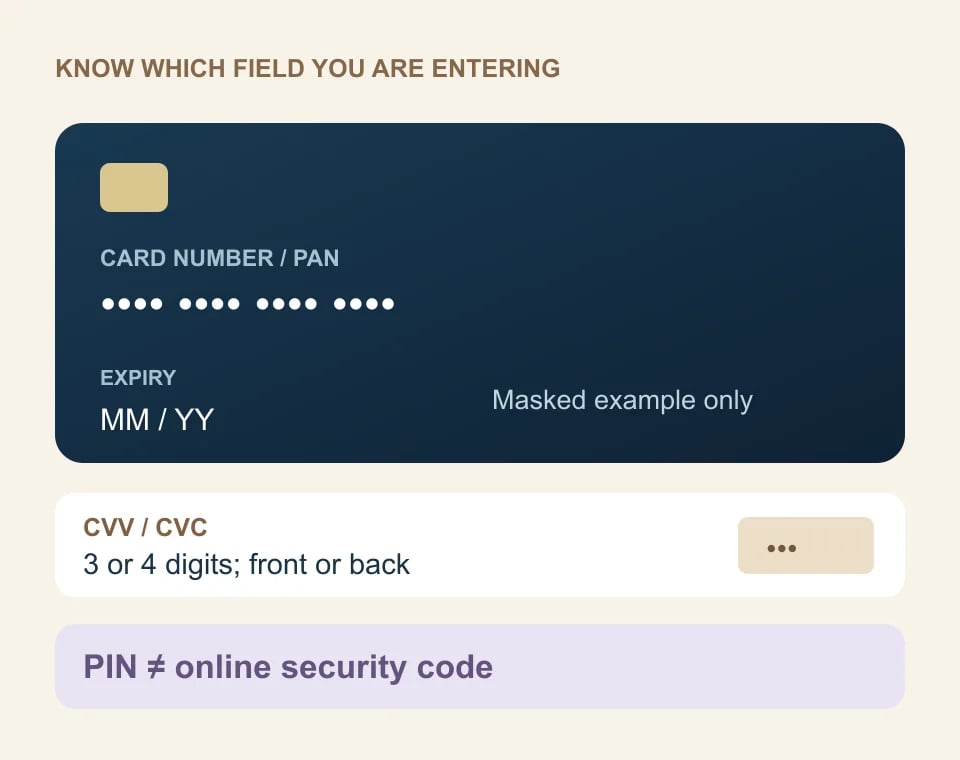
The main card number is often called the PAN, short for Primary Account Number. Many cards have 16 digits, but this is not universal. American Express cards, for example, commonly have 15. The layout, accepted length and other format rules depend on the network and product. Chase’s card-number explanation provides examples of these differences.
The opening digits include an issuer identifier, commonly called an IIN or BIN. Older explanations often describe only six-digit BINs, but eight-digit BINs also exist. Mastercard documents this change in its BIN expansion guidance. Do not build a form or a lookup rule on the assumption that every issuer prefix has six digits.
The remaining digits distinguish the card account within the numbering scheme and include a check digit in common card formats. That mathematical check can catch certain input mistakes. It cannot show who owns the card, reveal its balance or establish whether the issuer will approve a transaction. A plausible number is only plausible input.
The expiry date is another field, usually written as month and year. Enter it in the format requested by the checkout. If a replacement card arrives, compare its details with any saved payment methods instead of assuming every field stayed the same. Update legitimate services through their own account settings.
CVV, CVC and PIN: three terms worth separating
CVV and CVC are names used for card verification or security codes. Depending on the card brand, the code typically has three or four digits and may appear on the front or back. American Express explains its four-digit front-of-card code in its security-code guide. A card’s physical or digital presentation can vary.
A PIN serves a different role in supported cardholder-verification situations, such as certain in-person payments or ATM use. Do not put your PIN into a website field asking for CVV or CVC. An online payment may also involve a separate bank authentication step, but that is not an invitation to share your banking password or approval codes with someone contacting you.
| Detail | Main role | What it does not establish |
|---|---|---|
| Card number | Identifies the card account for processing | Ownership, available credit or approval |
| Expiry date | States the card’s expiry month and year | That the card is currently usable |
| CVV / CVC | Supports card-not-present verification | That a website or seller is trustworthy |
| PIN | Supports verification in applicable payment channels | A substitute for the online security-code field |
For merchants and developers, security codes are sensitive authentication data. PCI DSS prohibits retaining them after authorization, even when encrypted. Use your payment provider’s supported integration rather than storing a copy for convenience. See the PCI Security Standards Council’s explanation.
A checksum can help catch a typing mistake. Only the payment process can answer whether a particular transaction is approved.
Statement balance, current balance and minimum payment
Your statement summarizes an account period. Its statement balance is the amount recorded at that closing point. Your current balance can change afterward as purchases, payments, refunds, interest or fees post. Your minimum payment is the amount the issuer requires for that period; it is not necessarily the amount needed to avoid purchase interest.
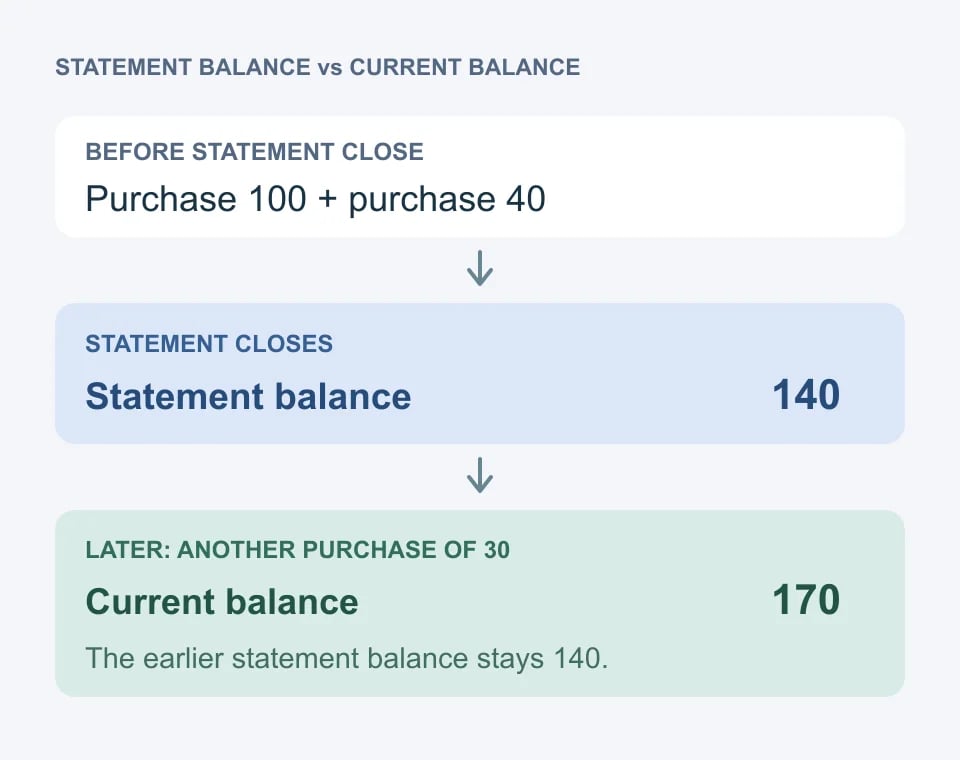
Consider the simple example in the graphic. You make purchases of 100 and 40 before the statement closes, then spend another 30 afterward. The statement balance remains 140, while the current balance becomes 170 under those assumptions. That difference is not an error: the later purchase belongs to a later statement period.
Now imagine opening the payment screen and seeing all three labels. Before choosing an amount, identify the statement’s due date and read how the issuer describes each option. If you use automatic payments, check whether they are set to the minimum, a fixed amount or the full statement balance. The word “automatic” alone does not tell you how much will be paid.
When does credit card interest apply?
Many cards offer a purchase grace period between statement closing and the payment due date. If your card provides one and you meet its conditions, paying the full statement balance by the due date can avoid interest on purchases. Carrying a balance can change that treatment, including for new purchases.
Cash advances commonly work differently and may begin accruing interest immediately. Promotional rates, balance transfers and fees can have separate terms. Paying only the minimum can leave a balance that accrues interest. Check your own agreement instead of assuming every transaction has the same interest-free period. The CFPB’s explanation of grace periods describes the distinction in the US context; product terms and rules elsewhere may differ.
Common questions about credit cards
Is the credit limit the amount I should spend?
The limit is the issuer’s borrowing boundary, not a spending target or a personal budget. Available credit can also reflect transactions and holds that have not yet reached a statement. Review what you can repay and the terms of your account before relying on the displayed limit.
Is my card number the same as my IBAN?
No. An IBAN identifies a bank account using an international bank-account format. A card number belongs to card-payment processing. You cannot replace one with the other in a form. Our article on what an IBAN is explains the account side with examples.
Can a card validator tell whether a card has money?
No. A format check does not contact the issuer to verify a live balance, ownership or account status. A tool may recognize a supported numbering pattern and check its consistency. Payment authorization is a separate process carried out through payment providers and the issuer.
Can I use generated card details to test a checkout?
Use the card test-data generator for isolated interface and formatting tests. Generated values are synthetic, not spending credentials. For an actual payment integration, use the test cards and scenarios supplied by your payment provider in its sandbox. Those scenarios let you test expected approvals, declines and authentication flows without treating a random valid-looking number as a real card.