
Fantasy Name Generator: Create Names That Belong in Your World
Turn a list of fantasy names into a world that feels connected. Build memorable characters, believable places and distinctive guilds with practical naming examples.
You have a mountain city, a missing courier and a guild with something to hide. Then the writing stops because everyone still has a placeholder name. A fantasy name generator can get you moving again, but a long list of impressive syllables is only a starting point. The useful part is choosing names that fit together and remain easy to recognize.
This guide follows one small example: a river valley where a mountain settlement trades with a forest town. We will name a courier, two places and a guild, then check whether they sound as though they belong to the same story. The example names are editorial inventions for the exercise, not claims about real languages or guaranteed generator output.
What does a fantasy name generator actually do?
A fantasy name generator creates suggestions from a set of naming rules or patterns. Different tools work differently. Genory combines original name-building elements with profiles, structures and style options. Its fantasy-name generation runs in your browser; it does not send a character biography to a conversational AI and ask it to invent a personalized history.
That distinction helps set useful expectations. A generator can supply a name with a particular sound, length or structure. It cannot decide that your courier secretly belongs to a noble family unless you develop that connection yourself. Treat the output as material to shape: keep a promising given name, revise a surname, or attach a title that matters in your setting.
Open the Fantasy Name Generator to explore the available choices. If you already know the type you need, focused tools such as the Elf Name Generator, Dwarf Name Generator and Guild Name Generator offer a more direct starting point.
Write a naming brief before generating
A naming brief is a few decisions, not another worldbuilding project. For the river-valley story, our courier needs a short name that is easy to call across a crowded room. The mountain settlement should feel older and heavier. The guild should sound respectable in public, even if its members are hiding something.
| Question | Example decision | Why it helps |
|---|---|---|
| What am I naming? | A courier, two settlements and a guild | Each needs a different kind of identity |
| What tone fits? | Grounded adventure with a little mystery | Avoids unrelated styles in one small setting |
| How will the name be used? | Spoken in a tabletop session and written in notes | Pronunciation and quick recognition matter |
| What should distinguish it? | Short person name; concrete place names | Gives readers more than one recognition cue |
For your own project, write one sentence such as: “I need a short, approachable name for a forest-born guide in a tense political adventure.” This gives you a reason to reject a suggestion that sounds magnificent but belongs to an entirely different story. You are selecting for a role, not trying to find the most elaborate word.
Build a character name in layers
A character name can carry several kinds of information. A given name distinguishes the individual. A family name, place-name attachment or byname connects them to other people. A title communicates how someone sees them. You do not have to use every layer whenever the character speaks.
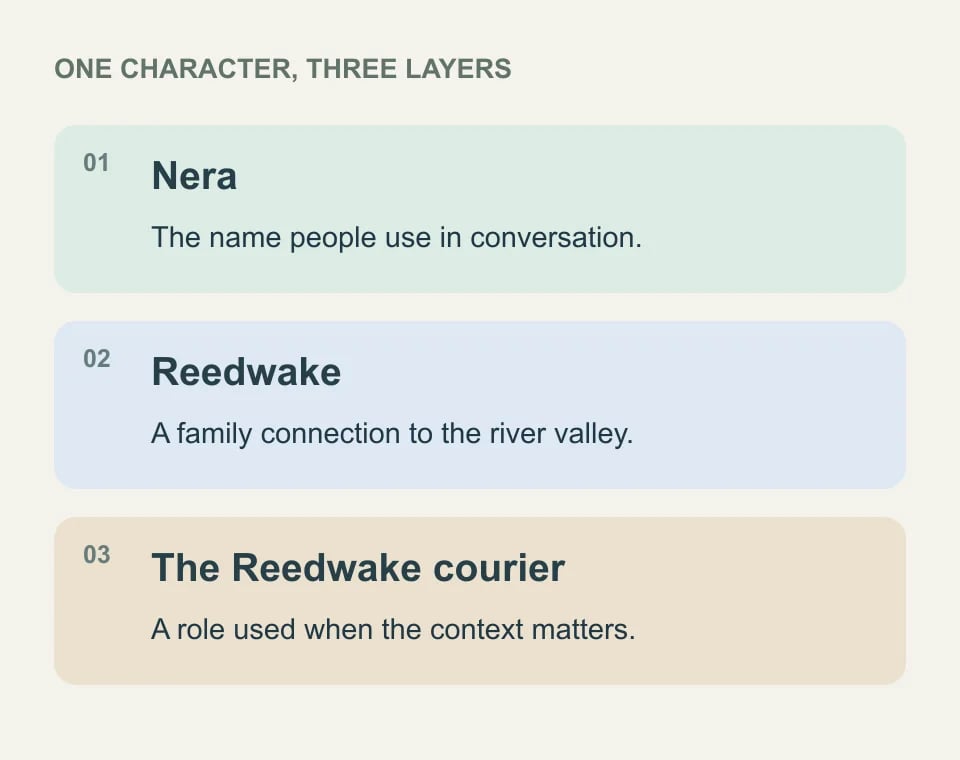
Our courier becomes Nera Reedwake. Most dialogue can use Nera. A formal introduction might use the full name; a hostile official might call her “the Reedwake courier.” Those variations add context without requiring three different identities for the reader to remember. If a title adds no useful information, leave it out.
Contrast matters across the cast. Nera, Nerin and Neraya might each work alone, yet become difficult to distinguish in the same scene. Try a different first sound, length or rhythm for the next important character. A supporting gatekeeper called Bram is easier to separate from Nera than another name beginning with Ner.
A memorable name gives the reader something to recognize. A useful naming system gives that recognition somewhere to belong.
How to choose a sound without stereotyping a character
You can use repeated sounds to connect a fictional community, but they need not define everyone’s personality. A gentle character can have a clipped name; a villain can have an elegant one. Choose patterns for the setting, then let characters contradict expectations through their actions. Genory’s style labels are creative controls, not rules about a person’s morality, ancestry or identity.
Make places and guilds feel connected
For this example, the mountain settlement is Greywake, and the forest town is Reedhaven. Their names share a plain-language approach without being almost identical. The courier’s surname, Reedwake, borrows an echo from each place. We can decide that her family once worked along the trade route between them.
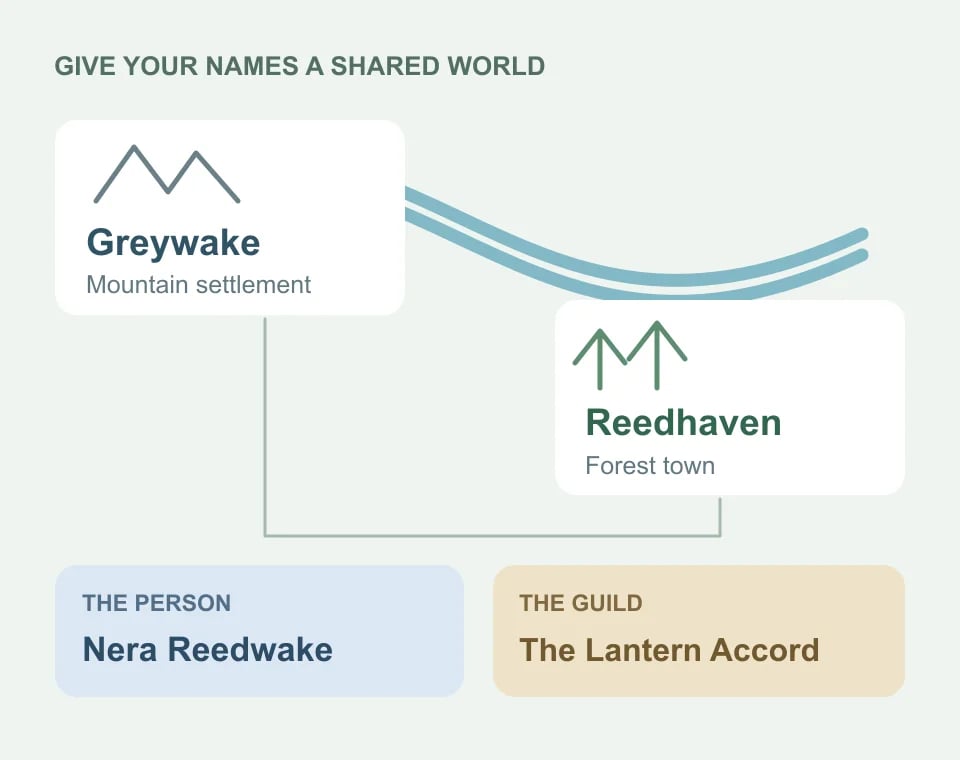
The guild becomes the Lantern Accord. “Lantern” suggests guidance and night travel; “Accord” suggests an agreement. Those are associations we choose to build into the story, not an etymology supplied by the generator. Perhaps the guild began by protecting travelers, and its current leaders still use that reputation to win trust.
This is a useful way to connect a few names without making every location end in the same syllable. Repeat an image, a historical reference or a naming convention. Then vary the actual words. The Fantasy Place Name Generator can help you gather alternatives before you decide which pattern your map should follow.
Use Genory’s settings with a purpose
In the main hub, start with your own world or choose an available universe. Then choose the relevant type and character or other naming profile. Available choices depend on the selection; not every universe offers every kind of name. The focused pages can take you directly to a particular type or collection.
| Control | When it helps | A useful first experiment |
|---|---|---|
| Style | The sound feels too plain or too ornate | Compare Classic with one contrasting style |
| Name length | Names are awkward in dialogue | Try Short before adding a family name |
| Structure | You need an identity beyond a given name | Compare a given name with name + family name |
| First letter | Your cast has too many similar initials | Choose a different starting letter |
| Seed | You want to revisit the same generated series | Save it alongside the generator and settings |
The styles are Classic, Dark, Mystic, Elegant, Rough and Heroic. They alter naming elements; they do not write a backstory. Gender options appear only where the selected character profile supports them. Advanced options include structure, a first letter and an optional seed. The first-letter setting applies to the name after any title, rather than forcing the title itself to start with that letter.
Generate ten names first, then save a few possibilities. Genory also offers batches of twenty or fifty, but a larger batch is not automatically a better decision. Change one setting at a time so you can tell why you prefer the next set. If every result feels unsuitable, revisit the profile or the naming brief instead of endlessly rerolling the same choice.
Choose a shortlist you can actually use
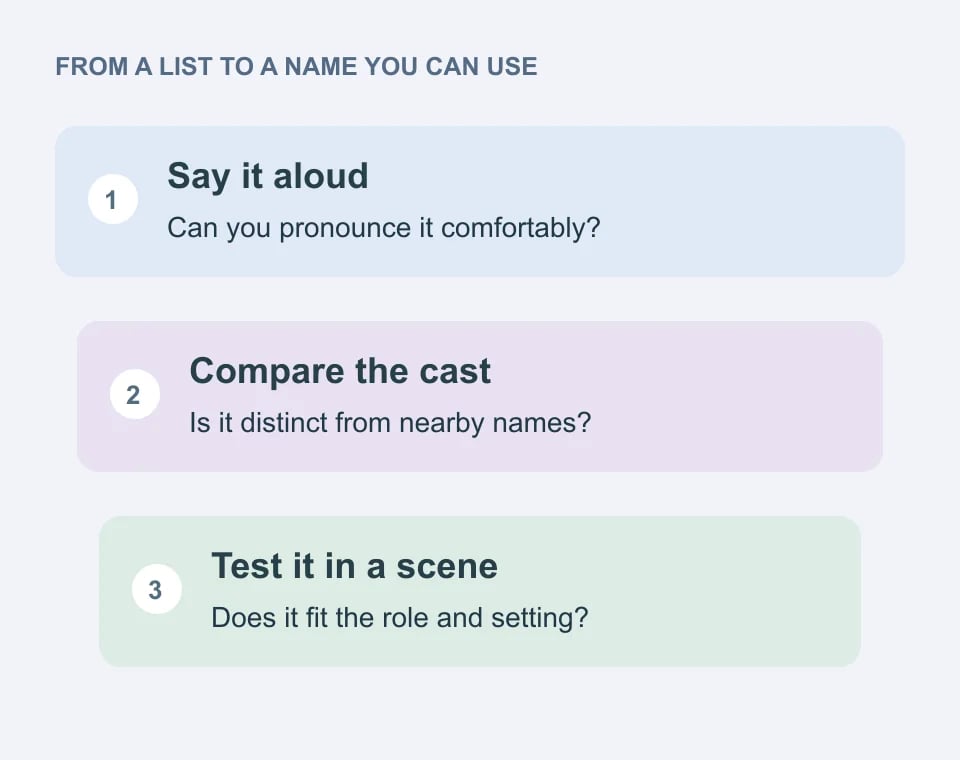
- Read it aloud. Say the name in an ordinary sentence, not only as a dramatic introduction. If you stumble, shorten it or write down a pronunciation you can use consistently.
- Compare it with the cast. Look for similar initials, repeated endings and names that become confusing when spoken quickly.
- Put it in context. Try “Nera reached Greywake before dusk” and “The Lantern Accord refused the crossing.” Does each name do its job?
- Record the decision. Keep the chosen spelling, role, pronunciation note and any relationships in your story notes.
For a game character, also check the game’s actual naming rules and availability. A generator does not reserve the name or check every server. For a story, search distinctive candidates if avoiding accidental associations matters to you. A search can reveal obvious overlaps, but it is not a guarantee that a name has never been used anywhere.
Keep the interesting part; simplify the rest
If a candidate has a strong opening but a difficult ending, edit it. You might keep its rhythm and remove a syllable, or preserve a striking family name while choosing a simpler given name. Apostrophes and unusual spelling are optional tools, not requirements for fantasy. Use them when they support a consistent convention rather than as automatic decoration.
Save favorites and reproduce a useful batch
Use the heart beside a result to keep a favorite, or copy one name or the entire batch into your working notes. Guest favorites are stored in the current browser. Signed-in favorites use the account’s saved collection. A guest list is not silently imported when you sign in, so copy important choices before changing how you work.
A seed lets the generator reproduce a series when you keep the same generator, settings and engine/catalog version. Save those details together. The generator link is useful for reopening a selection, but it does not encode every setting or preserve your chosen results. For a long-running novel or campaign, the actual name list is the durable reference.
Common questions about fantasy name generators
Is Genory’s fantasy name generator free?
Fantasy-name generation is free and runs locally in the browser without using the test-data generation quota. Account favorites are a separate saving feature. You can start generating and copying names without first building a large saved collection.
Can I use it for D&D, Skyrim or World of Warcraft?
Genory includes fan-inspired collections, with focused pages for D&D names, Skyrim names and World of Warcraft names. Suggestions use original building blocks. They are not an official character database, a translator for a fictional language or a guarantee of canon-accurate naming.
Will every name be unique?
The generator avoids duplicate strings within a successfully generated batch, but it does not promise uniqueness across people, projects or the wider internet. Saving a favorite does not register ownership or reserve a username. Check the requirements of the place where you intend to use it.
How do I get a name with a specific meaning?
Decide the meaning first and build it into your story deliberately. You can adapt a name, attach a meaningful byname or connect it to a place or event. Do not assume an invented syllable translates as “moon,” “fire” or “king.” If you use an actual language, verify the meaning with a reliable language source.
What if none of the names feels right?
Return to the brief. Change the profile, simplify the structure or compare two styles. Keep one promising fragment and edit it yourself. The goal is not to surrender the naming decision: it is to get past a blank page and make a choice you can use. Start with the Fantasy Name Generator, name one character, then build the surrounding world one connection at a time.