How to Measure Bra Size and Read an EU Size Chart
Take bust and underbust measurements, interpret an EU size chart and compare sister sizes. A practical guide to using a calculated size as a starting point for fit.
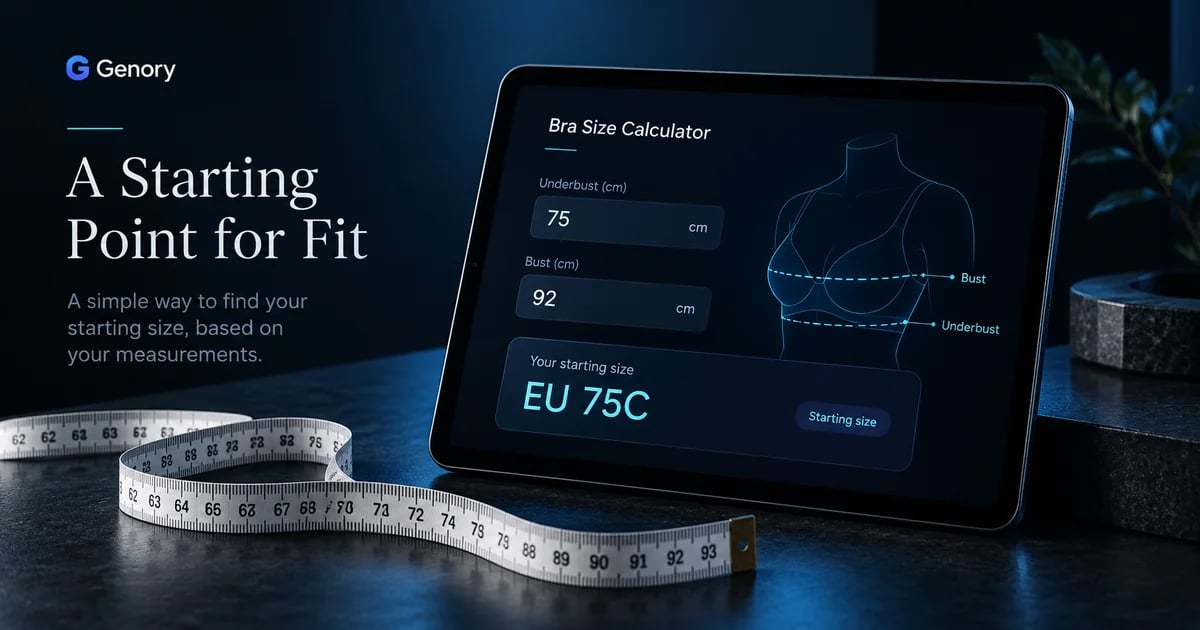
A measurement of 75 cm under the bust and 92 cm around the bust produces EU 75C in Genory's two-measurement chart. That label gives you a size to try. The fit of the actual bra still depends on its shape and construction, and you may prefer a neighbouring size in a particular style.
Start with those two facts together. A calculator can map measurements to a table consistently. It cannot see how a band rests on your body or how a specific cup contains your bust when you move.
The Genory Bra Size Calculator uses a stated EU chart and accepts centimetres or inches. It also shows neighbouring sister sizes. Its measurements stay in the browser: the tool neither sends them to Genory nor saves them for a later visit. You can inspect the method below the result without creating an account.
Take the measurements with the tape level
Use a flexible measuring tape that has not stretched. Check which side shows centimetres and which shows inches before reading it. A mixed-unit entry can look plausible while producing an entirely different result.
For the underbust measurement, place the tape directly below the bust and hold it snugly. Keep it horizontal around your body. You should be able to breathe normally. Read the measurement after the tape settles rather than pulling it tighter just to reach a round number.
For the bust measurement, bring the tape around the fullest part. Let it rest against your body without compressing the bust. A mirror can help you see whether the tape rises or falls at the back. If getting it level is difficult, another person can help you read it.
Anita's fitting guidance describes underbust and bust measurement positions and treats the calculated size as a guide for trying on. Its method can be taken over a well-fitting bra, preferably without underwires. If you use a manufacturer's instructions, follow that method consistently rather than mixing steps from several calculators.
Repeat a measurement when the tape moves or the reading surprises you. There is little benefit in recording a decimal to great precision if the tape position changes between attempts. A note such as “about 75 cm” can be more honest than an unsupported claim of laboratory accuracy.
The number and letter belong together
In an EU size such as 75C, the number identifies the band category and the letter identifies the cup category within that system. The letter has meaning in combination with the band. A C cup does not represent a single fixed volume across every band size.
This is why comparing letters alone often leads to confusion. Changing the band while keeping the same letter also changes the size of the cup in the grading system. When comparing two labels, read the complete size and check which sizing system the shop uses.
Genory rounds the underbust measurement to the nearest 5 cm band step. A measurement of 75 cm maps to band 75. The tool supports band labels from 60 to 110; that is the coverage of this calculator, not a statement about which bodies or products exist.
Cup size is selected using the difference between your measured bust and measured underbust. For the opening example, 92 minus 75 gives 17 cm. That difference falls in the C interval used here.
The chart used by this calculator
This implementation uses 2 cm cup intervals, beginning at a 10 cm difference for AA. The interval includes its lower boundary and excludes its upper boundary. A difference of exactly 16 cm therefore starts the C interval; a difference just below 16 cm stays in B.
| Bust minus underbust | Cup in this chart |
|---|---|
| 10 to less than 12 cm | AA |
| 12 to less than 14 cm | A |
| 14 to less than 16 cm | B |
| 16 to less than 18 cm | C |
| 18 to less than 20 cm | D |
| 20 to less than 22 cm | E |
| 22 to less than 24 cm | F |
| 24 to less than 26 cm | G |
| 26 to less than 28 cm | H |
The interval reference is Triumph's measurement guidance, which presents cup categories based on the bust-underbust difference. That New Zealand guide uses AU cup labels: its DD step corresponds to EU E in the international conversion table. Band labels and subsequent cup steps can be compared with the Europe column in Triumph's size charts. Genory applies an explicit boundary convention so decimal entries have one consistent output.
A different calculator may use additional measurements or a different fitting approach. A brand can also grade particular styles differently. Treat a disagreement as a reason to inspect the method and the product chart. There is no useful way to resolve it by choosing whichever label looks more familiar.
Near a boundary, check the neighbouring size
Suppose your underbust is 75 cm and your bust reading varies between 90.9 and 91.1 cm. Those readings sit on either side of a cup boundary in this chart. The output may move between B and C even though the measuring tape moved only a little.
The calculator flags measurements near a boundary. Repeat the reading with the same posture and tape position, then keep the neighbouring size in mind during an actual fitting. A boundary is a feature of a table. It does not represent a sudden physical change in your body.
The same issue exists for the band. An exact halfway measurement rounds up to the next 5 cm step. If your measurement lies close to that point, the two neighbouring band sizes are both worth comparing against the manufacturer's recommendations and the feel of the product.
An error outside the supported chart is also a coverage message. It does not mean the measurement is wrong. Check the entry and unit first, then use a brand chart that includes the relevant range instead of forcing the value into the nearest available option.
Sister sizes change the band and cup together
Starting from 75C, this chart shows 70D as the neighbouring size with a firmer band and 80B as the neighbouring size with a looser band. Moving down one band step moves up one cup step; moving up a band step moves down one cup step.
Those combinations aim for similar cup volume within a grading system. They are useful candidates for comparison when the band needs adjustment. They do not guarantee an identical cup shape, and the straps or placement may feel different in the actual product.
Use the distinction deliberately. If a 75C band feels too loose while the cups otherwise suit you, 70D is a candidate to try. If the band feels comfortable but the cups seem too small, changing only to a sister size may miss the problem. Compare the next cup on the same band and read the fitting advice for that design.
At the edge of Genory's chart, one of the neighbouring sizes may be unavailable in the output. The tool labels that limitation instead of inventing a cup letter outside its defined range. A retailer may carry additional sizes even when this calculator does not describe them.
Check the fit in the product you want to wear
When trying a bra, check the band separately from the cups. Look at how it rests around your body and whether it stays where you expect as you move. Then inspect the cup edges and how the bust sits inside the cups. Adjust the straps as intended for the product before deciding whether the overall fit works for you.
These observations are more useful than insisting that every style must match one saved number. Record what happens in a specific design: “band feels loose,” “cup edge presses,” or “space at the top.” That gives a fitter or a retailer something concrete to work with.
Choose comfort over loyalty to a calculated label. If the result and your experience disagree, use the result to narrow the next comparison. A professional fitting can also help when several nearby sizes remain difficult to distinguish. This guide offers general fitting information and does not assess medical concerns.
Inches change the input, not the sizing system
The unit switch converts the entered measurements. It does not change the output to a UK or US size. Genory continues to display EU labels, and the result panel names that system explicitly.
Do not divide an EU band label by 2.54 to invent an international size. The label refers to a category in a sizing system, and the cup sequence also needs the appropriate conversion chart. Read the retailer's system name and use its own conversion table when ordering from another market.
For repeated comparisons, keep the original measurements and the system name together in your own notes. “75C EU, from 75 cm and 92 cm using this chart” is much easier to interpret later than a cup letter on its own. The calculator deliberately avoids storing those personal measurements for you.
Compare a sale price after checking the size
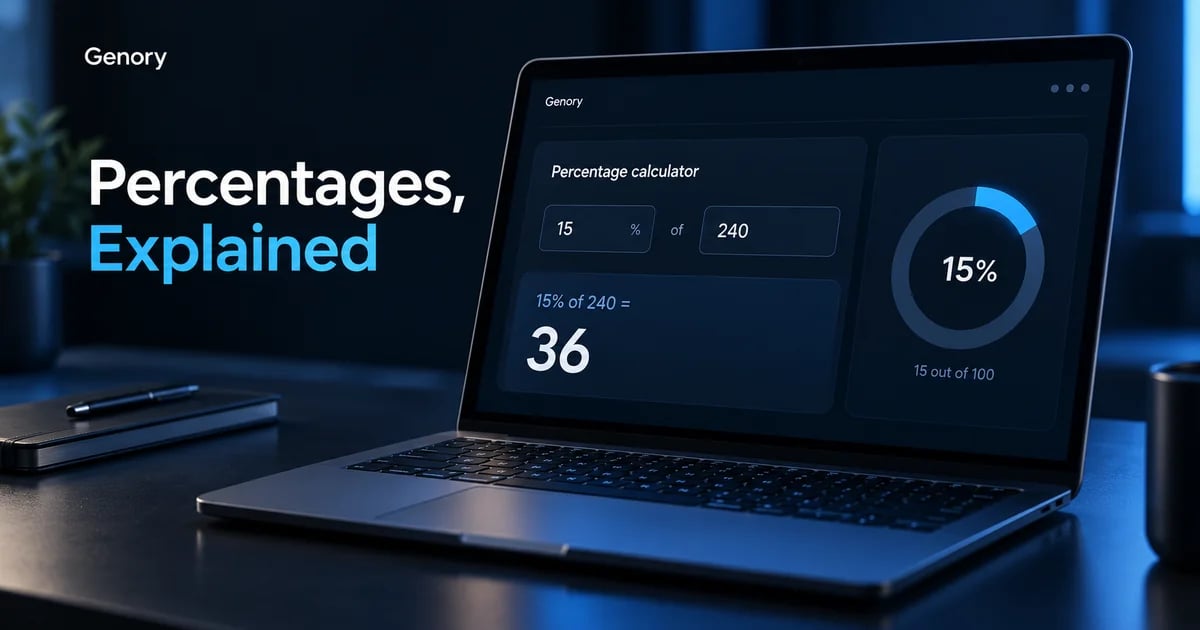
Once you have a suitable size and style, a sale calculation becomes useful. A bra marked at 60 with a 25% reduction costs 45 before any additional charges. Another at 50 with 10% off reaches the same item price. The larger discount percentage does not automatically produce the cheaper purchase.
The percentage calculations guide explains that comparison, successive discounts and the difference between a saving and a final price. You can run your own figures in the Percentage Calculator. Check the conditions of the particular offer, including which items qualify and what happens if the fit leads to a return.
Keep the measurement result as a starting point you can revisit. The next useful step is to compare a suitable product in that size with the nearby option indicated by the fit. A chart helps make that choice less arbitrary; the actual garment supplies the remaining information.